Webhooker
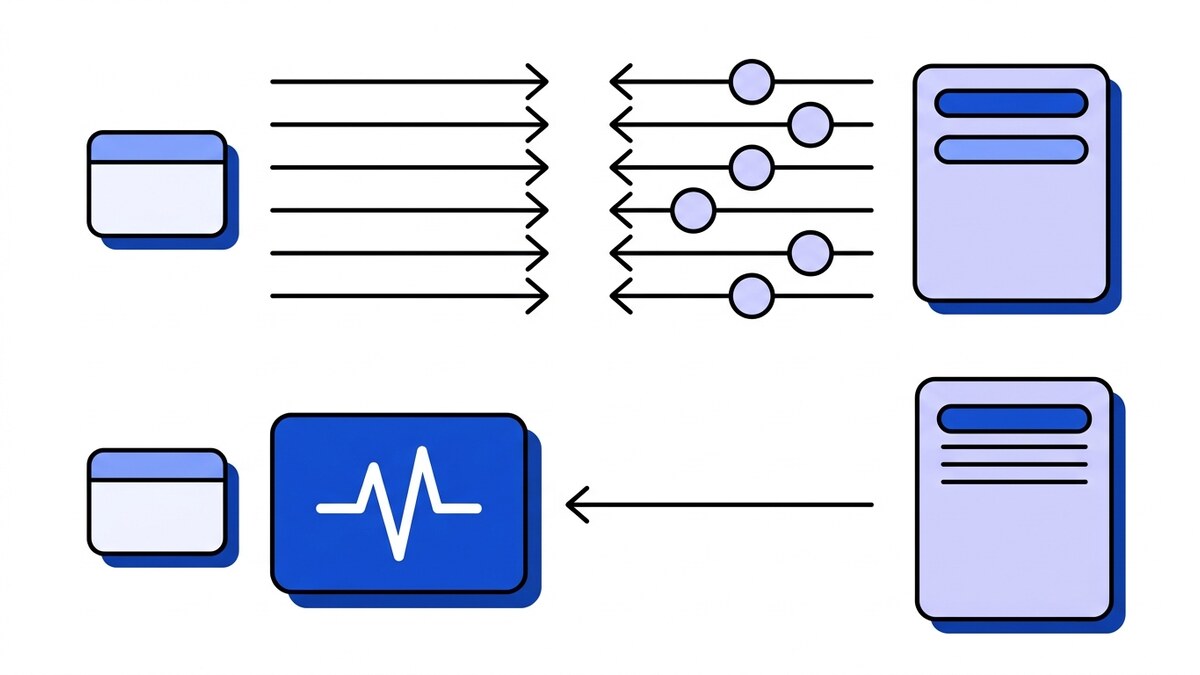
An API gives you data when you ask for it. A webhook sends you data the moment something happens, without being asked. You call an API; a webhook calls you. That is the webhook vs API difference in one line, and most explanations stop there.
They rarely cover what changes on your side of the wire once you switch. (New to the term? What a webhook is covers the basics, and one exchange in full shows the mechanics.) Calling or polling an API is something your code does on its own schedule, and if a call fails you retry it. Receiving a webhook means running a public HTTP endpoint that a company you do not control will POST to at a moment you cannot predict, exactly once if you are lucky. The direction reverses, and so does the responsibility for reliability.
The one-sentence version, and why it is not enough
The usual comparison table is correct as far as it goes:
| API (request/response) | Webhook (event push) | |
|---|---|---|
| Who starts it | You | The provider |
| When it happens | When you decide | When an event occurs |
| Data freshness | As fresh as your last call | Immediate |
| Who must be available | The provider | You |
| Cost of no news | A wasted request | Nothing sent at all |
The fourth row matters most, and many versions of this table leave it out. With an API, if your service is down, nothing happens; you call later. With a webhook, if your service is down when the event fires, the event was still sent. Whether you ever see it depends on the provider’s retry policy, which you do not control and which differs a lot from one provider to the next.
So the trade is less about push or pull than about availability. Switching to webhooks moves the requirement to stay up from the provider to you.
What you traded away when you stopped polling
Polling gets a bad reputation it only partly deserves. The case against it is real: to notice an event within a minute you have to ask every minute, forever, and almost every one of those calls returns nothing new. You burn rate limits, you burn CPU on both ends, and you still have up to a minute of lag.
Webhooks fix all of that. In exchange, you inherit five problems that polling never had:
Your endpoint is now public. Anyone who learns the URL can POST to it. A polling client has no attack surface at all; a webhook receiver has one on the open internet, which is why signature verification is not optional and why a valid signature still needs a timestamp check to stop replays.
Delivery is at-least-once, never exactly-once. If the provider sends an event and your acknowledgement is lost on the way back, it looks like a failure and gets sent again. You already did the work. Your handler now has to be idempotent or it will double-charge someone.
Order is not guaranteed. Stripe says this outright: creating a subscription can fire customer.subscription.created, invoice.created, and invoice.paid in whatever order they arrive. A handler that assumes created precedes updated will eventually act on a resource it thinks does not exist yet. Polling handed you the current state; webhooks hand you a sequence of state changes, and sequences can arrive shuffled.
You must answer fast. Most providers treat a slow response as a failed one; GitHub, for example, wants a 2xx within 10 seconds. Do your real work inside the request handler, and one slow database query turns into a retry storm from a provider that thinks you are down.
Silence is ambiguous. With polling, no new data is a fact you confirmed. With webhooks, nothing arriving could mean nothing happened, or it could mean your endpoint has been returning 500 for six hours and the provider gave up. You do not find out until someone asks why an order never shipped.
Webhooks are still often the right choice. Each of these five problems just needs code or infrastructure on your side before you can rely on them.
The hybrid nobody explains: a webhook as a doorbell
Many integrations that handle money end up using both, and comparison articles rarely mention it.
The webhook payload tells you that something happened and gives you an id. Your code then calls the API to fetch the current state of that object. The event is the trigger; the API is the source of truth.
1. webhook arrives:  { "type": "invoice.paid", "data": { "id": "in_1P9x..." } }
2. verify signature, return 200 immediately
3. queue a job
4. job calls GET /v1/invoices/in_1P9x...   <- current state, from the API
5. act on what the API returned
This solves the ordering problem outright. It does not matter whether invoice.paid overtakes invoice.created in flight, because you are not reconstructing state from the sequence of payloads. You are using each event as a hint that something is worth re-reading, then reading it.
It also sidesteps stale data. A webhook payload is a snapshot of the moment the event fired. If three updates happen in quick succession, the first webhook’s body is already outdated by the time your worker picks it up. The API always gives you now.
The cost is one extra round trip per event, and a dependency on the provider’s API being up when your worker runs. For payments and anything where acting on stale data means acting wrongly, that trade is almost always worth it. Some providers make this explicit: Stripe’s newer thin events carry little more than an id and expect you to fetch the rest.
Use the payload directly when the event is self-contained and low-stakes: a Slack message, a deploy notification, a cache invalidation. For the chat end of that, a Discord webhook tester shows what the message will look like before a channel full of people sees it. Fetch from the API when money, state machines, or anything a human will dispute is involved.
Where WebSockets fit
WebSockets come up in the same conversation and solve a different problem. A WebSocket is a persistent, bidirectional connection your client holds open (RFC 6455). A webhook is a single HTTP request the server makes to you and then forgets about.
The practical split:
- WebSocket when the recipient is a browser or a mobile app, updates are frequent, and you need them within milliseconds. Live prices, chat, collaborative editing, a progress bar.
- Webhook when the recipient is a server, events are occasional, and you need durability more than speed. A payment cleared. A build finished. An order shipped.
A WebSocket that drops loses whatever was in flight unless you build replay on top. A webhook that fails can be retried and replayed from a queue, because each event is an independent request with its own lifecycle. That durability is the reason server-to-server integrations settled on webhooks rather than long-lived sockets.
So which one do you pick
Usually both. Webhooks vs APIs is rarely an either-or decision: most production integrations use APIs for reading and writing, webhooks for knowing when to read, and polling as a backstop.
Pick the API alone when you control the timing and freshness is not critical: nightly syncs, reports, anything a user triggers by clicking a button. It is the simplest option that works.
Add webhooks when the delay of polling costs you something, or when the event volume makes polling absurd. If you check every minute and something happens twice a day, you made 1,438 pointless requests. If a customer is staring at a spinner waiting for a payment to confirm, minutes of lag becomes a product problem.
Keep polling as a reconciliation job even after you add webhooks. A nightly sweep asks the provider “what did I miss?” and repairs any gaps. A webhook that never arrives raises no error on your side, so this pass is how you find out, and it takes an afternoon to write.
Staying with polling is also a legitimate choice. One provider, low volume, no payment data, and a cron job that runs every ten minutes is a perfectly good integration. You skip the public endpoint, the signature verification, the idempotency store, and the retry infrastructure entirely, and the system stays sized to the problem it solves.
What the webhook side actually costs to run
If you do choose webhooks, this is the work that follows, and it is the same work in every project: verify signatures per provider, answer in milliseconds and process out of band, persist events before acknowledging, retry with backoff and jitter, break the circuit on a dead destination, catch exhausted retries in a dead letter queue, and keep a per-attempt history so you can answer “did event X arrive?” with evidence. None of it is new engineering, but all of it needs maintaining. If you would rather not maintain it, the hosted gateways differ more than their landing pages suggest.
That list is what a webhook gateway is. Whether to write it yourself comes down to engineering time against a monthly bill, and build vs buy puts numbers on both sides.
Webhooker sits on the receiving side: the provider posts to an ingest URL, the signature is checked there, and the event is stored and retried against your service, up to six attempts over about five hours before it lands in a dead-letter queue you can replay from. The docs cover the setup. To see the availability shift from this post for yourself, create an ingest URL, register it as a test-mode webhook endpoint with a provider, stop your handler, trigger a few events, and watch the delivery attempts once the handler comes back.
Frequently asked questions
Is a webhook the same as an API?
Not quite, though they overlap. A webhook is delivered over HTTP the same way an API call is, and some people call it an API call in the opposite direction. The difference is who initiates: with an API your code makes the request, with a webhook the provider makes it to you. A provider’s webhook feature is usually documented as part of its API, which is why the terms blur.
Are webhooks reverse APIs?
It is a useful shorthand and a slightly misleading one. The direction is reversed, so “reverse API” captures the main idea. But an API is a broad interface with many operations, while a webhook is a single one-way notification with no response body that matters beyond a status code. You cannot query a webhook or ask it for a specific record.
What are the disadvantages of webhooks?
You have to run a publicly reachable endpoint and defend it, since anyone who learns the URL can POST to it. Delivery is at-least-once, so duplicates arrive and your handler must be idempotent. Events can land out of order. Failures are silent, meaning a broken endpoint looks exactly like a quiet period until someone notices missing data. And local development needs a tunnel or a forwarding CLI, because a provider cannot reach your laptop.
Can I use webhooks and APIs together?
That is the strongest pattern for anything important. Let the webhook tell you an event occurred and carry an id, then call the API to fetch the object’s current state before acting. You get the immediacy of push with the correctness of pull, and out-of-order or stale payloads stop being a problem because the API always returns the present state.
When is polling still the better choice?
When the integration is small, the data is not time-sensitive, or you cannot expose a public endpoint at all, which is common behind strict corporate networks. A cron job hitting an API on a schedule has no attack surface, no duplicate handling, and no retry infrastructure to maintain. Even with webhooks in place, keep a periodic reconciliation poll to catch events that never arrived.