Webhooker
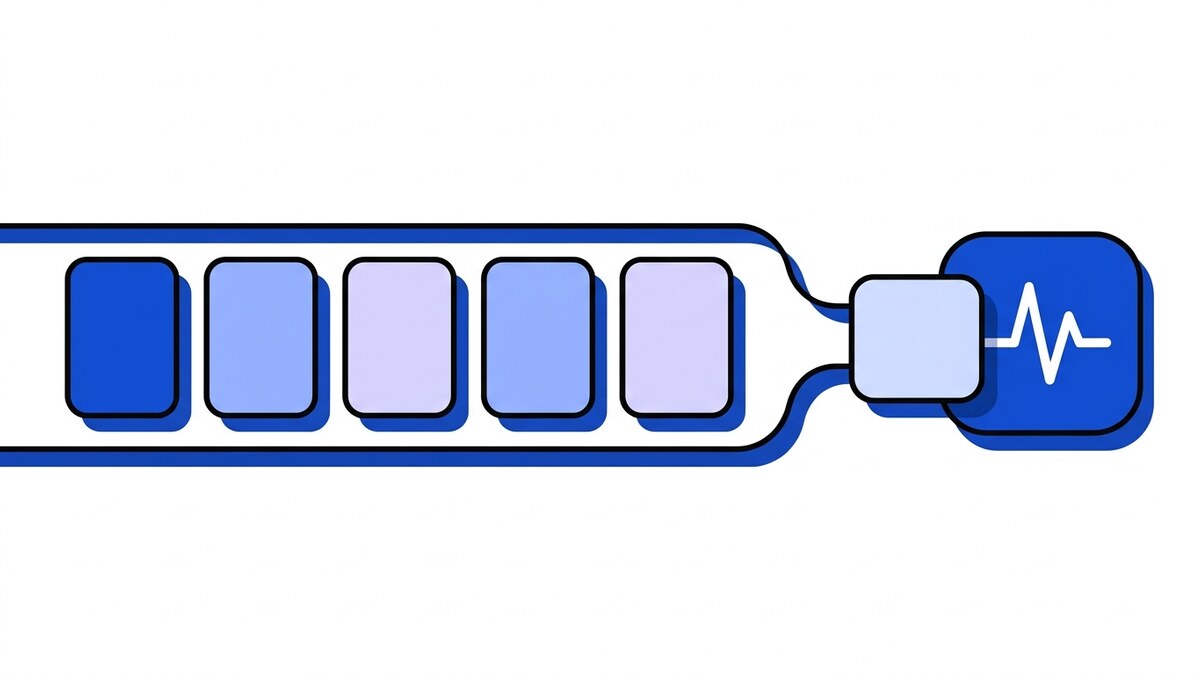
The HTTP delivery model gives you no webhook ordering. Webhooks arrive out of order because parallel workers, per-destination retries, and provider-side concurrency all break the original sequence. Ordered webhook delivery fixes that by holding one in-flight delivery per ordering key, so the next event waits for the previous acknowledgement. The cost is head-of-line blocking: one slow destination stalls everything queued behind it. Ordering also does not remove duplicates, and it orders the requests you receive rather than the work you do after acknowledging them, so idempotent consumers stay mandatory.
Most teams meet this problem the hard way. An event that logically came second lands first, some piece of state gets overwritten with an older value, and the bug resists reproduction because it depends on timing nobody controls. The instinct is to reach for strict ordering. Sometimes that is right, but a cheaper pattern often solves the same problem without the throughput penalty, so figure out which case you have before you turn FIFO on.
Why webhooks arrive out of order
Nothing in the webhook model promises order. Each event is an independent HTTP POST. The sender fires them, the network reorders them, and the receiver has no built-in notion of sequence. Three separate layers each add their own shuffle.
The provider sends concurrently. When one action generates several events, the provider dispatches them from a pool rather than one at a time. Stripe states it directly in its webhooks documentation: event delivery order is not guaranteed, and a single new subscription can produce four events that land in any sequence, as our Stripe webhooks guide walks through. Most large providers take the same position, because guaranteeing global order across millions of destinations would mean guaranteeing that no destination is ever slow.
Retries move events through time. A delivery that fails at 14:00:01 and finally succeeds on its fourth attempt at 14:00:15 lands after events created ten seconds later. The retry policy is working as intended when this happens. We wrote separately about how retries reshuffle the delivery order, and the short version is that any backoff curve is also a reordering function.
Delivery is parallel by design. In a typical gateway, competing workers claim deliveries from a shared queue and forward them out of band. Ten workers pulling from the same queue will finish in whatever order the destinations respond. The same parallelism that keeps a queue drained during a spike destroys ordering.
The bug this causes
The canonical failure looks like this. A customer cancels. Your billing provider emits customer.subscription.updated and then customer.subscription.deleted a few hundred milliseconds apart. The deleted event reaches your endpoint first because it happened to get a warm worker. The updated event, carrying the pre-cancellation state, arrives a second later and writes status: active back over the row you just tombstoned.
The account is live again and nobody is billed for it. It surfaces weeks later when someone asks why a cancelled customer still has API access. Nothing in your logs looks wrong: both events were delivered, both returned 200, both were processed exactly as written. The ordering assumption was never stated anywhere, which is why it was never checked.
When ordering genuinely matters
Pay for ordering when the meaning of an event depends on the events before it. Three patterns qualify:
- State machines keyed to one entity. A subscription, an order, a shipment. The events are transitions, not snapshots, and applying them out of sequence produces a state the machine can never legally reach.
- Financial ledgers built from deltas. If you compute a balance by applying
+50,-20,-40in sequence with an overdraft check between each step, reordering changes which step trips the check. - Inventory decrements and other non-commutative arithmetic.
reserve 3thenrelease 3is fine in either order only if the intermediate state is never read. It usually is.
The inverse also holds. Ordering buys you nothing when:
- The payload carries full state. If every
order.updatedwebhook contains the complete order, applying the newest one wins regardless of arrival order. You need a version check, not a queue. - The operation is commutative or idempotent. Cache invalidation, search reindexing, “send this to Slack”. Running them twice or backwards costs nothing.
- The data is append-only. Analytics events, audit trails, log shipping. They are sorted at read time, if at all.
Sort your destinations into these buckets one by one. In most systems only one or two need ordering.
How ordered delivery works
Ordered delivery is a constraint on concurrency, expressed per ordering key: whatever identifies the entity whose history must stay intact, usually a customer ID, a subscription ID, or an order number pulled from a field in the payload.
For each key, the webhook gateway keeps exactly one delivery in flight. Event two is not attempted until event one is acknowledged with a success status or has exhausted its retries. Different keys still run in parallel, so customer_A and customer_B move independently. Order is preserved inside a key and nowhere else.
Choosing the key is the main design decision. A key of customer_id gives you strict ordering per customer and full parallelism across your customer base. A key of source gives you one serial pipeline for every event from that provider, which is ordered and also a bottleneck. The narrower the key, the less you pay. Queue systems make the same trade: AWS documents it as the message group in SQS FIFO queues, where throughput scales with the number of distinct groups.
The guarantee stops at your door. Ordered delivery controls the sequence of HTTP requests, not the sequence in which your handler finishes them. If your endpoint writes the request to your own queue and returns 200 so background workers can pick it up, you have re-parallelised the events the gateway just serialised, and the ordering is gone before anything reaches your database. FIFO delivery becomes FIFO processing only if the handler does the ordering-sensitive work (or at least commits it) before it acknowledges.
What ordering costs
Head-of-line blocking. Most of the cost comes from this. If the delivery at the front of a key’s queue is slow, everything behind it waits. If it is failing, everything behind it waits through the entire backoff curve (first attempt, second, fourth, capped) before the queue moves. Retries and the per-destination circuit breaker still apply in ordered mode. That is correct behavior, and it also means a tripped breaker now holds a whole queue instead of one delivery.
Throughput per key collapses to serial. Without ordering, a key’s events are limited by your worker pool. With ordering, they are limited by the round-trip time of your destination, one delivery at a time. There is no useful benchmark number to give here: what matters is your own endpoint’s response time multiplied by your events per key.
Latency becomes coupled. In an unordered pipeline a stuck delivery is one stuck delivery. An ordered pipeline degrades in blocks, and the p99 you care about is no longer a property of a single request. FIFO is still the right tool for some destinations, as long as you choose it knowing these costs.
The simplest alternative: refetch the resource
The cheapest fix is to stop trusting the payload. Treat each webhook as a signal that something about an entity changed, discard the body, and read the current state from the provider’s API before you act on it. Whatever order the events arrive in, the read returns the current state. A late customer.subscription.updated cannot resurrect a cancelled account, because it triggers a read that comes back cancelled.
This is what Stripe means when it tells you to retrieve the object instead of trusting the event, and it is a common fix after a first ordering bug. It handles duplicates too: two reads of the same resource produce the same answer, so a redelivery is harmless without any bookkeeping. We made the wider case for it in treating a webhook as a signal rather than a payload.
What you pay is one API call per event, against the provider’s rate limit. At low volume that is nothing. At high volume, or when the provider exposes no read endpoint for what the event describes, the cost adds up, and the next two options become the better fit.
The middle option: version-aware consumers
If the extra read is too expensive, check whether your provider already tells you the order. Most do, through a monotonic sequence number, a version field, or an updated_at timestamp on the resource. If it does, your consumer can reject stale events itself, with no second call:
on_event(event):
    key      = event.payload.subscription_id
    incoming = event.payload.updated_at   # or a version / sequence number

    current = store.get_version(key)
    if current is not null and incoming <= current:
        return 200   # stale or duplicate, already superseded

    store.apply(key, event.payload, version=incoming)
The pattern runs at full parallelism, needs no coordination in the gateway, and has a property FIFO lacks: it also filters duplicates. A redelivered event carries a version you have already applied, so the same comparison drops it. Keep in mind why ordering and duplicates are separate problems: one check happens to handle both here, but the guarantees are different.
Two caveats. Timestamps are only safe if they come from the provider and have enough resolution. Two events in the same millisecond compare as equal, so prefer an explicit sequence or version field when one exists. And the pattern needs snapshot payloads, where the newest event contains everything you need. If your events are deltas that must all be applied, discarding the stale one loses data, and you need strict ordering after all.
Choosing between the three
Table: the three ways to survive out-of-order webhooks, and what each one asks of you.
| Question | Refetch on event | Version-aware consumer | Ordered delivery (FIFO) |
|---|---|---|---|
| Payload shape it needs | None, the body is discarded | Full-state snapshots | Deltas or transitions |
| Provider must supply | A readable endpoint for the resource | A sequence, version, or updated_at | Nothing extra |
| Throughput per key | Unbounded, plus one API call each | Unbounded by ordering | Serial, one delivery in flight |
| Effect of a slow destination | That delivery only | That delivery only | Blocks the whole key |
| Handles duplicates | Yes, the read is idempotent | Yes, same check | No — still at-least-once |
| Where the work lives | Your consumer and the provider’s API | Your consumer code | Gateway configuration |
| Plan required | Any | Any | Team |
Read it left to right and stop at the first column that works. If you can absorb the extra read, refetching is the least machinery for the strongest correctness. If you cannot, but your payloads carry full state and a version, the version check costs nothing at runtime. Only when every event must be applied, and applied in sequence, do you need the queue. At that point you are accepting head-of-line blocking knowingly instead of finding it in production.
Ordered delivery on Webhooker
Ordered delivery is available on the Team plan. It is not part of Free or Pro. It is gated by tier instead of metered, which is relevant when you compare pricing models across vendors. It is configured per destination, so you can serialize the one endpoint that runs a state machine while the rest of your destinations keep delivering in parallel. Turning FIFO on for every destination would apply head-of-line blocking to traffic that never needed ordering.
Everything else stays as it is:
- Delivery remains at-least-once, so consumers still need to be idempotent. Ordering constrains when a delivery is attempted; it does not change how many times it may succeed.
- Retries and the per-destination circuit breaker still apply.
- The dead-letter queue still catches exhausted deliveries with their full per-attempt history.
- The other per-destination delivery controls (transformations, header injection, outbound signing, rate limits) are the same on every plan, including the Free plan. Plan limits and prices for the Team plan are on the pricing page.
Frequently asked questions
Why do webhooks arrive out of order?
Because three layers each reorder them independently. Providers dispatch events from a worker pool rather than one at a time, so two events created milliseconds apart can leave in either sequence. Retries move a failed event forward in time, past events created after it. And gateways deliver in parallel, so ten workers finish in whatever order the destinations respond. None of this is a bug: guaranteeing global order would mean guaranteeing that no destination is ever slow. Stripe says so in its own webhook documentation, and most large providers take the same position.
Does ordered delivery guarantee no duplicates?
No. Ordering and deduplication are different guarantees. Webhooker delivers at-least-once, which means a delivery whose acknowledgement is lost in transit will be retried and may be processed twice, ordered or not. What ordering guarantees is that event two is not attempted before event one has finished. It says nothing about event one being attempted only once. Your consumer still needs to be idempotent, keyed on a stable event identifier, the same as without ordering enabled.
Does ordered delivery mean my handler processes events in order?
Only if your handler does the work before it responds. Ordered delivery serializes the requests we send: request two is not dispatched until request one is acknowledged. If your endpoint’s answer to request one is to push it onto your own queue and return 200 straight away, your background workers pick both events up concurrently and the ordering you paid for is gone before either one is written. Either do the ordering-sensitive part synchronously, or carry the ordering key into your own queue and serialize on it there.
What happens when a destination is down?
The queue for that ordering key stops. The failing delivery retries with exponential backoff, and every event behind it waits for that curve to finish. If the per-destination circuit breaker trips, deliveries are held until it closes again. Once the delivery exhausts its attempts it moves to the dead-letter queue and the next event proceeds, so the queue is never blocked permanently. This is head-of-line blocking working as designed, and it is the main reason to scope ordering keys narrowly.
Can I order some destinations and not others?
Yes. Ordered delivery is a per-destination setting on the Team plan, not a workspace-wide switch. A typical setup serializes the destination that drives subscription or order state and leaves analytics, Slack notifications, and search indexing running in parallel. Since one inbound event can fan out to several destinations, and fan-out is not billed separately, this costs you nothing extra. The ordered destination moves at its own pace while the others keep up with the queue.