Webhooker
The closest Hookdeck alternatives for an EU team are the gateways that receive webhooks and can keep the data in Europe: Webhooker, Svix Ingest and Convoy. HookGet, wehook.io, Ploq and Hook0 are also hosted in the EU and show up in the same lists, but they were built to send webhooks to your customers, which is what Hookdeck Outpost does. Event Gateway receives. Decide which of those two jobs you are replacing before you compare prices.
We build Webhooker, one of the products on this page, so weigh what follows with that in mind. Every fact about another vendor links to that vendor’s own pricing page, documentation, privacy policy or license file, checked on 14 September 2026. Prices, limits and regions change often, so treat the links as the source and this page as a map.
Why do teams look for a Hookdeck alternative?
Most migrations come down to one of four reasons.
Data residency and GDPR paperwork. A gateway does more than forward bytes. It stores payloads while they wait, keeps response bodies and per-attempt logs, and parks failed deliveries in a dead-letter queue for hours or days. That data carries names, emails and order contents. When your DPO asks where it lives, “the provider has an EU region” is only half an answer. The other half is where the workers, the retry buffer, the backups and every sub-processor run.
Pricing model fit. Gateways bill on different units: inbound events, delivery attempts, destinations, connections, or a blend. The unit matters more than the headline price. If you fan one order event out to three destinations and pay for three, your bill follows your architecture as much as your traffic. We wrote separately on how to compare pricing models fairly, because it is hard to do by eye.
Inbound versus outbound focus. “Webhook infrastructure” covers two problems that share a word. Receiving events from Stripe, GitHub and your PSP is one. Sending events to your own customers, with endpoint management and a portal for their developers, is the other. A tool built for the second is usually awkward at the first.
Surface area you do not need. Some teams have exactly one problem (Stripe events must never be lost) and end up on a platform with a much broader remit. The platform may be fine. The mismatch still costs money and attention.
What is Hookdeck good at?
Hookdeck sells two products. Event Gateway receives: it verifies signatures with built-in support for third-party providers, makes up to 50 automatic retries with unlimited manual and bulk retries, and offers JavaScript transformations and filters. Outpost sends, and is Apache 2.0 licensed. The product is mature, and debugging is where it has invested most.
The facts that usually start the search are on Hookdeck’s own pages. Its comparison article says “Event Gateway is currently hosted in the US only”. The pricing page sets retention at 3 days on the free Developer plan (one user), 7 days on Team (from $39 a month) and 30 days on Growth (from $499 a month), and Growth is also where uptime SLAs and SSO start. A static IP is a $100 add-on. Outpost’s managed EU region starts on its Growth plan too.
Hookdeck publishes its own Event Gateway alternatives page, which compares it with Svix Ingest and Convoy. Read it alongside this page, keeping in mind that it does not mention hosting regions.
If you cannot name the constraint that sends you looking in one sentence, switching gateways is a lateral move. You pay for a migration, rebuild dashboards and runbooks, and land on a different set of trade-offs. The four reasons above justify that cost. A general feeling that something better exists usually does not.
Which criteria decide the choice?
Every gateway ticks “retries” and “replay”, so feature grids tell you little. These are the questions that separate one product from another.
Table: the questions that decide a webhook gateway choice and why each one matters. Every answer is time-sensitive, so check them against each vendor’s current documentation.
| Criterion | What to ask | Why it decides |
|---|---|---|
| Hosting region | Where do ingest, storage, workers and backups each run? | One leg outside the region breaks the residency claim |
| Sub-processors | Who else touches the payload: hosting, email, logging, monitoring? | Your DPO needs the full list, including the vendors behind the front door |
| DPA | Available on the plan you would actually buy? | Without it you cannot document the controller-processor split |
| Direction | Built for receiving, sending, or both? | The wrong direction means fighting the tool daily |
| Verification | Which schemes, and checked before acceptance? | Verifying after delivery starts means acting on untrusted data |
| Failure handling | Backoff, circuit breaker, DLQ, bulk replay, per-attempt history | This is the reason a gateway exists |
| Transformations | Reshape payloads and inject headers per destination? | Otherwise adapter code moves back into your app |
| Billing unit | Event, attempt, destination or connection? Fan-out billed? | Decides whether cost tracks traffic or architecture |
| Overage | At 101% of quota: a bill, a throttle, or a warning? | Decides whether a spike is an incident or an invoice |
| Retention | How long are payloads and logs kept, and can you shorten it? | A debugging tool and a compliance liability at once |
| Ordering | Per-destination FIFO available, and on which plan? | Ordering costs head-of-line blocking, so global-only ordering is the wrong shape |
Answer those eleven for each candidate and most shortlists shrink to one or two names.
What are the best Hookdeck alternatives?
These are the products that come up most often when EU teams look for a Hookdeck alternative, in search results and in ChatGPT answers. Each cell comes from the vendor’s own site, checked on 14 September 2026.
Table: Hookdeck alternatives by direction, EU hosting, DPA and entry price. The sections below link to the source of each fact.
| Product | Built for | EU hosting | DPA | Free tier | Entry paid plan |
|---|---|---|---|---|---|
| Webhooker | Receiving | EU only (Hetzner, Germany) | Pro and Team | 10,000 events/mo, 14-day retention | €29/mo, 30-day retention |
| Svix Ingest | Receiving (Svix Dispatch sends) | Isolated EU region on every plan | EEA DPA from Professional | 50,000 messages/mo, 30-day retention | $490/mo |
| Convoy | Receiving and sending | Separate EU environment | Published DPA | 14-day trial; free self-hosted Community edition | Cloud from $99/mo |
| HookGet | Sending, with 27 verified inbound sources | Germany, some sub-processors outside the EU | Not stated on pricing page | 10,000 deliveries/mo, 3-day retention | $199/mo for 2M deliveries, 30-day retention |
| wehook.io | Sending (beta) | France only | Standard DPA at signup | 5,000 messages/mo, 7-day retention | €19/mo for 50,000, 15-day retention |
| Ploq | Sending | OVHcloud, France | DPA listing EU sub-processors | Pricing not public | Pricing not public |
| Hook0 | Sending | France, behind Cloudflare | Check with vendor | 100 events/day, 7-day retention | €59/mo, 14-day retention |
| ngrok | Edge verification and tunnels | Frankfurt point of presence | n/a | $5 one-time credit | Hobbyist $10/mo |
| Webhook Relay | Forwarding to private networks and localhost | Default tunnel region in Belgium | n/a | 150 webhooks/mo | Basic $8.99/mo |
Three of these replace Event Gateway like for like. Four are send-first services that replace Outpost, and the last two solve a narrower networking problem. “EU hosting” also means something different in each row, which is why the residency questions above ask about each leg separately.
Which EU-hosted gateways receive webhooks?
This category exists because of the first reason on the list. A gateway here is built to receive events and can name every place your data touches. Expect a per-source ingest URL, verification before acceptance, a durable queue, retries with a circuit breaker, a dead-letter queue with replay, delivery history you can hand to an auditor, and a DPA without a sales call. These tools are deliberately narrower, so do not expect much for the outbound case.
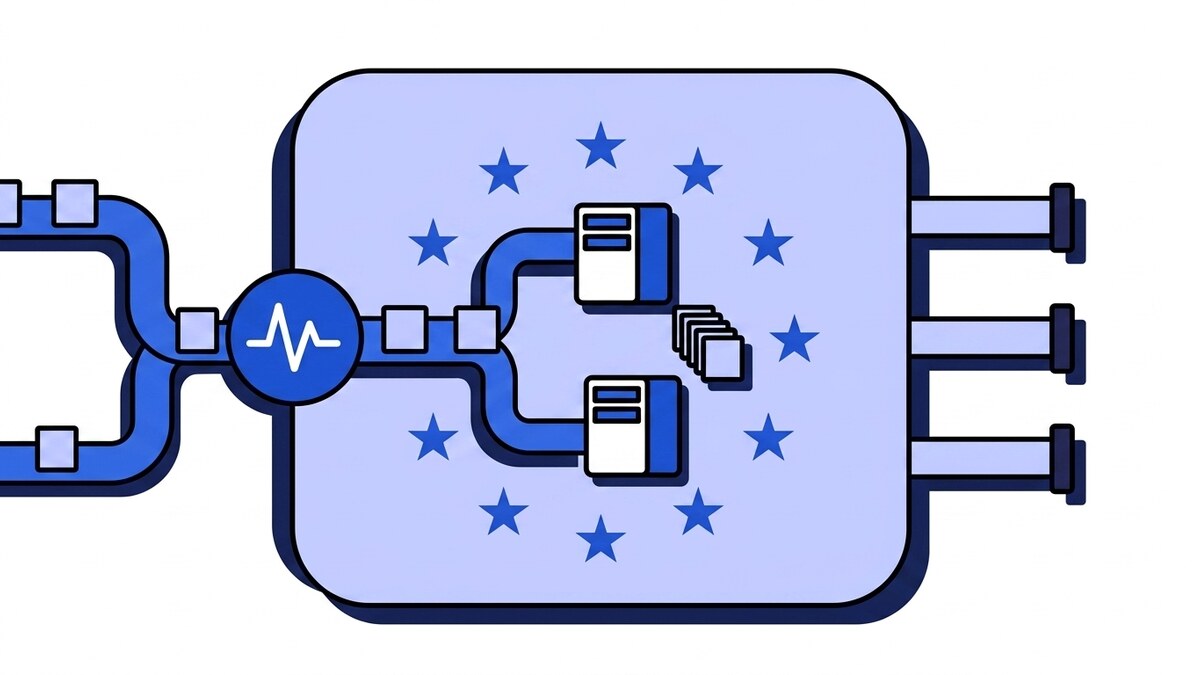
Webhooker sits here, with ingest, storage and delivery workers on Hetzner servers in Germany, backups kept in the EU, and retention limits enforced per plan. Each source gets its own ingest URL at https://app.webhooker.eu/in/{token}, which returns 200 OK straight away (99% of events are acknowledged in under 10 ms, measured server-side) while workers handle delivery out of band. Signatures are checked per source before the payload is accepted, with Stripe, GitHub and Shopify presets, generic HMAC-SHA256/SHA1, Basic Auth or an API key. Failed deliveries get up to six attempts over about five hours with exponential backoff, which is fewer automatic attempts than Hookdeck’s 50. A per-destination circuit breaker isolates an endpoint that is clearly down, and events that exhaust their attempts land in a dead-letter queue with one-click and bulk replay plus per-attempt history. Delivery is at-least-once, so your consumers still need to be idempotent. No gateway removes that obligation.
On billing, one event is one inbound webhook received. Fan-out is free, so routing an order event to your database, your analytics and a Slack alert costs the same as routing it to one place. There is no overage billing either: usage up to 120% of the monthly quota is free. Pricing starts with a free tier of 10,000 events a month across 3 sources, and both paid plans include a DPA. Ordered delivery and a static outbound IP are Team-plan only, so check those early if you need them.
Two other products belong here. Svix Ingest verifies signatures for named providers such as Stripe, retries failed deliveries and lets you replay them. Svix’s pricing page lists an isolated EU region on every plan, Free included, with 50,000 messages a month and 30-day retention before Professional at $490, where the EEA DPA starts. Convoy receives and sends through one platform and verifies incoming sources with HMAC, Basic Auth, API keys or custom modules. Its DPA says it runs separate EU and US environments and processes EU personal data within the EU, and cloud plans start at $99 a month. Neither is EU-only by design, so run the residency questions from the FAQ below against the region you would use.
For a head-to-head on hosting, retries, verification and cost at your volume, see Webhooker vs Hookdeck. You can also create a Webhooker account and point one non-critical source at it while you check the others.
Which EU-hosted services send webhooks?
The second category solves the mirror problem. These platforms exist so your product can send webhooks to your customers: subscriber and endpoint management, signing keys your users can rotate, a portal where their developers inspect deliveries, and retry policies per subscriber. If what you are replacing is Hookdeck Outpost, start here. Svix Dispatch belongs in this group too, alongside several smaller European services; our Svix alternatives guide compares them against Svix directly.
HookGet is the name ChatGPT suggested as a Frankfurt-hosted Hookdeck replacement when we asked it in September 2026. Its homepage describes a delivery service with 27 verified inbound sources, Stripe and SendGrid among them, and 8 retry attempts over about 21 hours before a dead-letter queue. The pricing page counts deliveries: Free covers 10,000 a month with 3-day retention and blocks traffic past the quota, Pro is $199 a month for 2 million with 30 days, and Scale is $449 for 20 million with 90 days. For a residency review, read its privacy policy (last updated 28 August 2026) in full. It lists compute on Hetzner in Falkenstein and Postgres on Neon in AWS eu-central-1, plus Cloudflare’s global edge, outbound email through Oracle Cloud in Jerusalem, and payments through SUMIT in Israel, a country covered by an EU adequacy decision. Its security page says there is no SOC 2 report today. If you mostly receive webhooks from providers that are not on its list of 27, it is a partial fit.
wehook.io sends webhooks from infrastructure it describes as 100% France-based, with the database, workers and payload storage all in France. It is in beta behind a request form. Plans run from a free tier of 5,000 messages with 7-day retention to Starter at €19 for 50,000 with 15 days and Growth at €89 for 500,000 with 30 days, and a standard DPA is signed at signup. Retries follow eight attempts over about 27 hours.
Ploq is a webhook delivery service run on OVHcloud in France. Its homepage says it uses no US hyperscalers and publishes a DPA that lists OVHcloud, Scaleway and Mollie as sub-processors. Prices are not on the public site.
Hook0 often shows up in Hookdeck-alternative lists even though it only sends webhooks. Its pricing page puts the cloud service in France by default, with a free tier of 100 events a day and a €59 Startup plan. Our Hook0 vs Hookdeck comparison goes through the two side by side.
Trouble starts when teams pick a sending platform for a receiving job because both are filed under “webhooks”. Receiving is a different shape. You do not control the sender, you cannot ask Stripe to change its retry policy, you verify a signature scheme somebody else designed, and your recovery tool is replay, since there is nothing to resubscribe. The test is one question: who owns the endpoint you are managing? If it belongs to your customer, you want this category. If it belongs to a provider you receive from, you want the previous one.
Is there a self-hosted Hookdeck alternative?
Yes, and building a small one yourself is also an option. A route that accepts a POST, verifies an HMAC and writes to a deliveries table in PostgreSQL, plus a worker pool that claims rows with SELECT ... FOR UPDATE SKIP LOCKED and forwards them with backoff, is an afternoon of work. For one low-stakes source it is the right amount of engineering.
Most of the cost arrives after the build: per-provider verification schemes that change, a circuit breaker so one dead destination cannot starve your workers, a replay UI somebody other than you can operate, per-attempt logs with response bodies, alerting, retention enforcement, and the on-call rotation that owns all of it at 2am. That work never finishes, and it competes with your product roadmap.
You do not have to start from zero. Several products publish their servers: Svix under the MIT license, Convoy as a free self-hosted Community edition with its source on GitHub under the Elastic License 2.0, which forbids offering it to others as a hosted service, Hook0 under SSPL-1.0, and Hookdeck’s own Outpost under Apache 2.0 for sending. Read the license before you build a product on top of one.
Build when webhook handling is close enough to your core product that owning it is an advantage, when compliance requires the data never to leave infrastructure you control, or when your volume makes any per-event price absurd. Otherwise you are funding a small permanent team to maintain a commodity.
Can Zapier or another automation platform replace Hookdeck?
At low volume with low stakes, yes. Zapier-style automation platforms will catch a webhook and do something with it, and a form submission that posts to a spreadsheet does not need a gateway.
They are weakest where a gateway has to be strong. Signature verification is often left to you or skipped, which leaves an endpoint anyone can POST to. Replay usually means re-running an automation rather than redelivering the stored event with its original payload. Delivery history is typically a run log with short retention and no per-attempt response bodies. Per-task pricing climbs quickly too, because webhooks arrive in bursts.
Use them as glue between SaaS tools. For payment events, put a gateway in front.
Where do ngrok and Webhook Relay fit?
Both come up in the same searches and solve a narrower problem. ngrok’s webhook gateway verifies signatures at the edge for more than 70 providers with its verify-webhook action, including a timestamp check against replays, and has a Frankfurt point of presence. The page does not describe retries, a queue or replay, so it filters traffic without storing it. Webhook Relay receives webhooks and forwards them to a public URL, a private server or localhost, with its default tunnel region in Belgium, Google Cloud as its main infrastructure provider, and a Basic plan at $8.99 a month.
Both are good at getting traffic into a network it could not otherwise reach. Neither replaces a durable store with a dead-letter queue if your requirement is never losing an event. For receiving webhooks on a laptop during development, we compare tunnels and relays in ngrok alternatives for webhooks.
How do you pick the right category?
Table: which category fits which constraint. Read the left column as the sentence you would use to describe your own situation.
| If this describes you | Look at |
|---|---|
| Personal or payment data in payloads, EU residency required, a DPO asking specifics | EU-hosted receiving gateway |
| Several providers to receive from; you need verification, replay and history | EU-hosted receiving gateway |
| Your product sends webhooks to your own customers | EU-hosted sending service |
| Webhook handling is core to your product, or volume makes per-event pricing absurd | Self-hosted or DIY |
| One low-stakes source, no personal data, no money involved | A plain endpoint or an automation platform |
| It works, region is not a constraint, and you cannot name a specific gap | Stay where you are |
Take the last row seriously. If Hookdeck is serving you, your residency requirements are met, and the billing unit matches how your traffic behaves, migrating buys you a project and no outcome. Repointing every provider, running both paths in parallel while you verify, rebuilding alerting and retraining whoever is on call should go toward a constraint you can name. For teams that have one (usually residency, sometimes the billing unit), running a single non-critical source through the new gateway for a couple of weeks takes most of the risk out of the move.
Once the shortlist is down to named products, Webhooker vs Svix vs Hookdeck compares the three receiving gateways on hosting region, DPA availability, billing unit, retries and replay.
Frequently asked questions
Is there a European alternative to Hookdeck?
Yes, several. For receiving webhooks, Webhooker keeps ingest, storage, workers and backups only in the EU, Svix Ingest offers an isolated EU region on every plan, and Convoy runs a separate EU cloud environment. For sending, HookGet runs in Germany, wehook.io and Ploq run in France, and Hook0 is hosted in France. The distinction to check is between EU-hosted and EU-only: many providers keep the primary database in the EU while email, logging, monitoring, payments or backups run elsewhere. Ask where ingest, storage, delivery workers and backups each run, then read the sub-processor list. Your DPO should still review the DPA, since you remain the controller.
Which Hookdeck alternative is closest to Event Gateway?
Svix Ingest, Convoy and Webhooker, because all three are built to receive webhooks from third-party providers, verify them, store them and redeliver on failure. HookGet, wehook.io, Ploq and Hook0 are closer to Hookdeck Outpost, since their core job is sending webhooks to your customers’ endpoints. HookGet does verify 27 named inbound sources, so it can cover receiving if your providers are on that list.
Is there a free Hookdeck alternative?
Webhooker’s free plan covers 10,000 events a month across 3 sources with 14-day retention. Svix’s free tier covers 50,000 messages a month with 30-day retention in an EU region, without the EEA DPA. HookGet and wehook.io have free tiers for sending, and Convoy’s Community edition is free if you host it yourself. Check whether the DPA you need is part of the free plan: at Webhooker and Svix it is not.
Can I migrate without changing provider URLs?
No. A gateway owns the ingest URL, so moving means updating the endpoint configured at every provider: Stripe, GitHub, your PSP, each one separately. What makes it low-risk is that most providers allow more than one endpoint per event type, so you can register the new gateway alongside the old one, compare what arrives on both for a week or two, and only then remove the original. Plan for a parallel period rather than a cutover.
What should I ask a provider about data residency?
Four questions, in this order. Where does ingest terminate? Where do payloads and queue state sit at rest, including the dead-letter queue? Where do the delivery workers that run retries execute? Where do backups and archives live? Then ask for the sub-processor list, because hosting, email, logging and monitoring vendors all see data too. Finally ask whether a DPA is available on the plan you would buy or only on enterprise contracts. The GDPR text defines the controller-processor split these answers have to satisfy; check the specifics with your DPO.